The instructional thinking behind my interactive learning experiences: the rationale, the objectives, the ADDIE process, and what I do not yet know. Implementation and evaluation for these experiences are in progress — no classroom results are claimed.
Design rationaleBUS 101 · Introduction to Business
Money Moves: The $3,500 Challenge
Learning or performance problem
BUS 101 students often meet personal finance as abstract concepts — interest rates, trade-offs, emergency funds. I designed Money Moves so students practise those ideas as decisions rather than definitions: six months of a fictional first-job budget, with a real-world event each month.
Intended audience
BUS 101 · Introduction to Business learners
Learning objectives
Construct a monthly budget within a fixed income.
Calculate how spending, debt payments and savings affect your financial position.
Evaluate trade-offs when unexpected expenses arise.
Defend a financial decision using numerical evidence.
ADDIE process
Analysis
BUS 101 serves cohorts of 45+ students, many managing their own money for the first time. Reading about APR and trade-offs is not enough — students needed concrete practice with budgeting, debt and savings.
Design
A six-month narrative with one real-world event per month. The starting position — $3,500 monthly take-home pay, $500 in checking, $300 in emergency savings and $4,000 of credit card debt at 22% APR — makes trade-offs real from the first month.
Development
Built as a browser simulation where every dollar is tracked and every calculation is shown, so the model stays transparent. Progress saves on the student’s device.
Feedback and assessment
Each decision produces immediate numerical feedback, and a “How calculations work” panel explains the maths behind every figure. The final position gives students numerical evidence they can use to defend their decisions.
Accessibility
Runs in a modern browser with no installation or account. The experience takes about 25 minutes and progress saves locally, so it can be paused and resumed.
Technology and development approach
Browser-based simulation developed with Lovable. See Development in the ADDIE process for documented interactions.
Evaluation plan
Proposed: assess learner explanations and decision evidence against the objectives; review accessibility and usability before classroom implementation. No evaluation results are claimed.
Limitations
All data is fictional and the simulation is not personalized financial advice. It has not yet been tested with a class, and no learning outcomes have been measured.
Entrepreneurship students often treat profit and cash as the same thing. Runway makes the difference felt rather than explained: you are the founder of a subscription business, and every pricing, marketing, hiring and financing decision moves your cash position.
Intended audience
ENT 200 learners
Learning objectives
Manage a startup’s cash position over twelve months.
Make pricing, marketing, hiring and financing decisions under uncertainty.
Distinguish profit from cash flow.
Respond to market shocks and decide whether to borrow or sell equity.
ADDIE process
Analysis
Designed for ENT 200, where students need to feel cash-flow pressure rather than read about it.
Design
A twelve-month structure with a visible starting position: $25,000 in cash, $2,500 monthly fixed expenses, 20 customers at $50 per month. A fixed scenario seed means every student replays the same events, which supports consistent grading.
Development
Built as a browser simulation with a “How the model works” panel, so the assumptions behind the numbers stay visible to students.
Evaluation
The shared scenario seed makes results comparable across students; measured learning outcomes are a placeholder.
Feedback and assessment
The cash position updates after every decision, and the fixed scenario seed lets students replay the same events and compare strategies.
Accessibility
Runs in a modern browser with no installation or account.
Technology and development approach
Browser-based simulation developed with Lovable. See Development in the ADDIE process for documented interactions.
Evaluation plan
Proposed: assess learner explanations and decision evidence against the objectives; review accessibility and usability before classroom implementation. No evaluation results are claimed.
Limitations
All financial assumptions and market responses are fictional and for instructional purposes. The simulation has not yet been tested with a class, and no learning outcomes have been measured.
New staff need to locate resources and apply organizational knowledge in context. This user-supplied project turns onboarding into scenario-based investigation.
Intended audience
Workplace onboarding learners
Learning objectives
Locate an appropriate resource for a workplace question.
Choose and explain a response to an onboarding scenario.
Use gathered evidence to justify a workplace decision.
Business concepts become concrete when learners make pricing and stock decisions and inspect their consequences. The supplied project uses a lemonade business as the setting.
Intended audience
Business and entrepreneurship learners
Learning objectives
Calculate revenue, costs, and profit from a trading day.
Choose price and stock levels using available information.
Explain how customer demand affects a business decision.
ZamStores: grocery delivery and e-commerce platform, Zambia
Context
ZamStores was one of the first grocery delivery and e-commerce platforms in Zambia, serving busy families and local vendors. It grew from a small pilot into a full operating service.
My Role
Product Manager, 2018–2022. I led product development and managed cross-functional teams, and built and managed the platform’s systems.
Approach
I designed customer workflows, product catalogs, order tracking and inventory logic to support daily operations. I used n8n and Zapier to automate order notifications, customer updates, stock adjustments and delivery coordination across several teams, and created internal dashboards so the team could track orders in real time.
Evidence
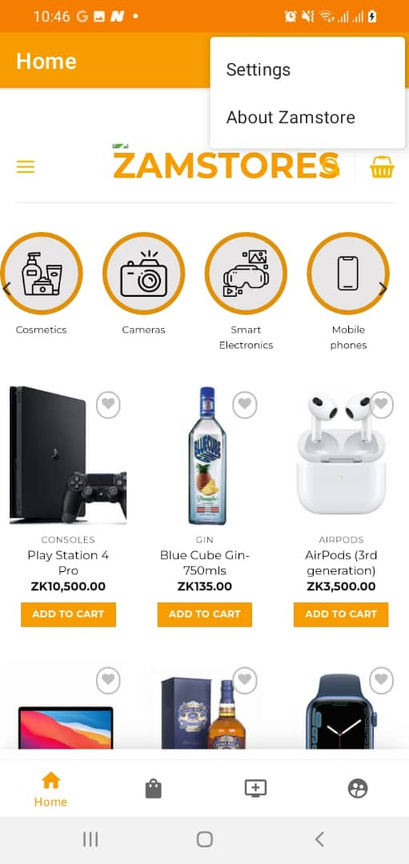
ZamStores mobile app: product catalog screenImage · From my professional portfolio
ZamStores logoImage · From my professional portfolio
Additional evidence in preparation: Dashboard or workflow diagram (no customer data).
Results
As described in my portfolio, the work improved the user experience, reduced manual workload, operational delays and support load, and helped the team reduce delays and prevent lost deliveries. No figures are reported here because none were supplied.
Reflection
My experience with ZamStores helped me appreciate that successful technology implementation involves more than developing a functional digital platform. It also requires understanding how people interact with a system, what challenges they encounter, and how technology can make their everyday tasks easier. Working on customer workflows, inventory processes, and order management reinforced the importance of designing technology around actual user needs. This experience connects to my current studies in instructional technology because both fields require careful analysis of users, thoughtful design, implementation, and continuous evaluation. One lesson I carry into my academic work is that technology should not be evaluated only by its features. Its value also depends on whether people can understand it, adopt it, and use it effectively.
Evidence in preparationProject record
Izzy Client Track: client tracking and intake system
Context
A client tracking system used to follow households, address history and services over time. Awaiting verification — the organization (listed in my portfolio as “State of Nevada”) and project dates.
My Role
Designer of the client tracking system. Awaiting verification — my exact title and role.
Approach
I connected intake forms, Google Sheets and reporting views with n8n and Zapier to remove double data entry.
Evidence
Additional evidence in preparation: Workflow diagram of intake to reporting (no client data), Reporting view screenshot with all client details removed.
Results
As described in my portfolio, the system improved data accuracy for audits and funding reports and made it easier for caseworkers to see the full story for each family. No figures are reported here because none were supplied.
Reflection
Working on client tracking and reporting systems strengthened my understanding of how information systems can support organizational learning and decision-making. The project demonstrated the importance of organizing information in ways that help staff understand client histories, coordinate services, and prepare accurate reports. It also highlighted how disconnected systems and repeated data entry can create unnecessary administrative work. This experience informs my interest in instructional design and workplace learning. Even when a technology solution is well designed, its effectiveness depends on whether users understand the system and can incorporate it into their daily responsibilities. As I continue my doctoral studies, I am increasingly interested in the relationship between technology design, user support, organizational processes, and sustained technology adoption.
ITLD 610 course projects
Evidence in preparationProject record
ITLD 610 Project 1: Technology Integration
Context
A course project for ITLD 610 Foundations of Instructional Technology and Learning Design, University of Nevada, Reno.
My Role
Doctoral student and instructional designer.
Approach
Designing instruction by aligning the topic, target learners, at least three learning outcomes, content, activities, assessments, and appropriate instructional technology.
Evidence
Additional evidence in preparation: Completed technology integration assignment.
Evidence in preparationProject record
ITLD 610 Project 2: Professional E-Portfolio
Context
A course project for ITLD 610 Foundations of Instructional Technology and Learning Design, University of Nevada, Reno. The portfolio you are reading is itself the artifact for this project.
My Role
Doctoral student and instructional designer.
Approach
Designing an evidence-based professional portfolio with a purpose statement, thematic organization, intuitive navigation, linked artifacts, and reflective documentation.
Evidence
Additional evidence in preparation: Completed e-portfolio assignment documentation.
Evidence in preparationProject record
ITLD 610 Project 3: Evaluation of AI-Generated Learning Materials
Context
A course project for ITLD 610 Foundations of Instructional Technology and Learning Design, University of Nevada, Reno.
My Role
Doctoral student and instructional designer.
Approach
Developing evaluation criteria, comparing an original instructional presentation with an AI-generated presentation, and assessing the quality of instructional design and technology integration.
Evidence
Additional evidence in preparation: Completed evaluation assignment.
Instructional technology and ADDIE-based design
Evidence in preparationProject record
BUS 101 learning management system and multimedia design
Context
Course delivery design for BUS 101 at the University of Nevada, Reno.
My Role
Instructional designer for my own course.
Approach
Course delivery, assessment frameworks and learning analytics in the university learning management system, used to identify and support at-risk students; accessible multimedia assets created in Canva.
Evidence
Additional evidence in preparation: Course module screenshot (no student data), Multimedia learning asset sample.